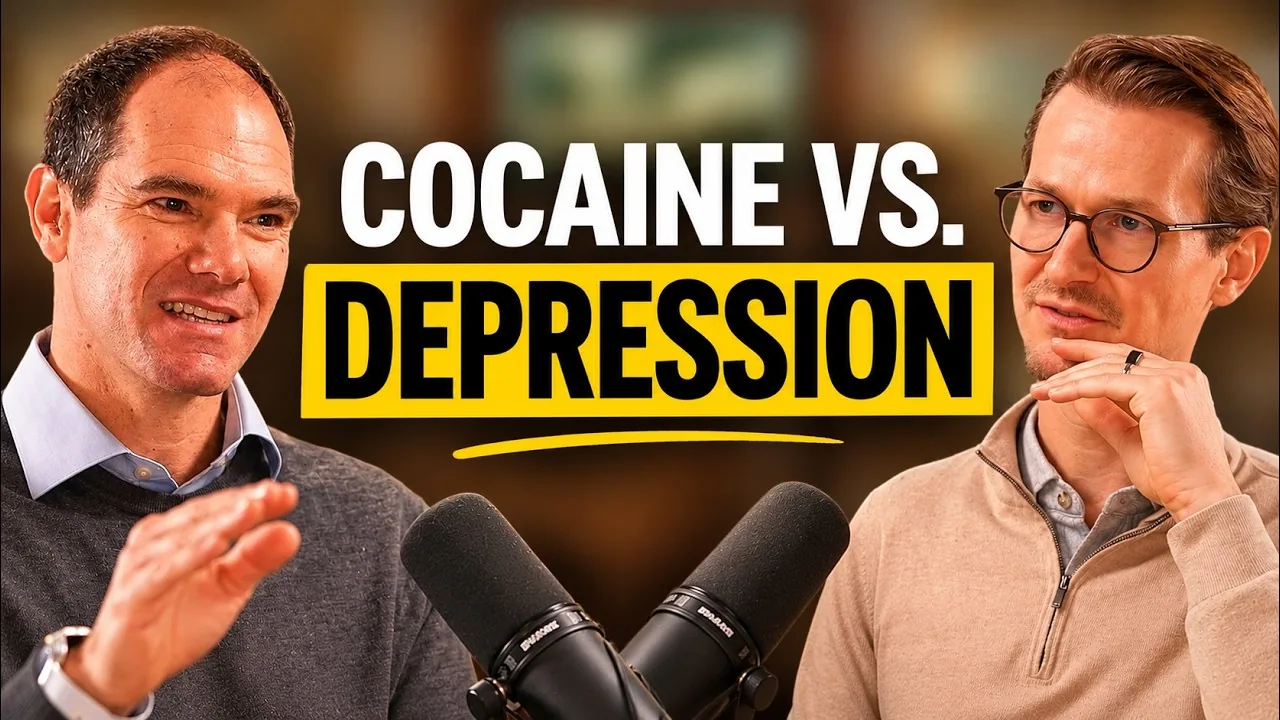
My Secret 30-Year Addiction That Is Coming for Our Children: Ore Oduba on Pornography, Shame and Speaking Out
In this episode of Rich, Powerful & Not Enough, host Jan Gerber, founder and CEO of Paracelsus Recovery in Zurich, talks with broadcaster and Strictly Come Dancing winner Ore Oduba about his addiction to pornography, which he says began when he was nine and lasted about 30 years. Oduba describes growing up in fear, learning to hide what he was going through, and the people-pleasing that followed him into a public career. He also explains what led him to therapy, why he chose to speak publicly, and what he thinks parents and adults should do to protect children.
Listen on
Key takeaways
- Ore Oduba says he was nine when he first saw pornography, at a friend's house, and that he had no reference point and no guidance around it, so he was left to make sense of it alone.
- Oduba says isolation felt like safety at first: a private space that nobody else knew about, which he links to why a regular cycle of dopamine hits can come to feel like the real you.
- According to Oduba, fear of his father and a need to be accepted taught him early that whatever he was going through could not be shared, a pattern that continued into his television career as a form of chronic people-pleasing.
- Oduba says he has learned in the last six months or so that he has ADHD, and that without understanding rejection or being told he was not the problem, pornography remained the available alternative.
- Oduba says that telling his therapist, who answered that it was more normal than he thought, was all he needed to know that he could share it with one person.
- Oduba says he decided to speak publicly after a year without returning to the addiction, when a report on children's exposure to pornography disappeared from the news within 24 hours.
- Oduba says the responsibility lies with adults, and that it starts at home with open, non-judgmental conversations about healthy sex and sexual relationships, because otherwise pornography will find children.
In this episode
- 00:00 Intro
- 02:42 From Newsround to Strictly Come Dancing and the celebrity abyss
- 06:40 Losing yourself to people-pleasing
- 11:45 Childhood, fear and hiding the truth
- 19:40 How pornography became a source of comfort
- 26:15 When isolation feels like safety
- 28:00 When pornography becomes a problem
- 31:25 ADHD, rejection and the search for connection
- 34:50 Protecting children in a digital world
- 38:50 Reaching breaking point
- 45:20 Starting therapy
- 54:05 Why he chose to speak publicly
- 01:01:35 The conversations parents need to have
What happens when a child is exposed to pornography at nine with no guidance?
Ore Oduba says he was nine when he first saw pornography, at a friend's house while the internet was new, and that with no reference point and no guidance he was left to make sense of it alone.
He places the first exposure at a playdate with a school friend who had an older brother. He remembers dial-up connections and the CD-ROMs from internet providers that arrived through the letterbox, and he recalls thinking as a boy that one of them might give him access to what he had seen. He describes that as complete ignorance and innocence. In his account, the danger lay in the environment around him, because nobody was there to talk to about it. He says the intrigue had been awakened and that he began looking to replicate that imagery everywhere he looked. He describes it as a kind of friendship, to the point of having an imaginary friend around early adolescence, and says it was already lacing itself into his psyche and neurology. Early in the conversation he also explains why he uses both "pornography" and "explicit adult imagery": the definition has broadened, and he thinks censorship of the language gets in the way of healthy conversations.
"I had no reference point and no guidance around it." Ore Oduba, 23:47
Why do fear and the need for acceptance lead people to hide the truth?
Ore Oduba says he learned in childhood that whatever he was going through could not be shared safely, and that a fear of failing and a need to be accepted shaped his adult life and his career.
He describes growing up in a suburban town in Dorset in a first-generation Nigerian family with four siblings, where education mattered a great deal and the expectations of his parents differed from the reality of the children's lives. He says the children were hit and grew up in fear of their father, whom he also says he appreciates for doing everything he could to raise four children in a country that was not his own. He recalls a moment on a family trip to Nigeria, when his father set out what would happen if a sibling's trouble at school were repeated, and says he knew from then that if he strayed, life would be over. Gerber raises the idea of authenticity versus attachment, which he attributes to Gabor Maté, and Oduba says it explains everything from the beginning. After winning Strictly Come Dancing he describes feeling like a chameleon for two to three years, wearing a different version of himself each day in the hope that somebody would accept him.
"Fear of failing and chronic people pleasing." Ore Oduba, 08:26
How do ADHD and rejection sensitivity fit into the story?
Ore Oduba says he has learned in the last six months or so that he has ADHD, and that without understanding rejection or being guided to see that he was not the issue, pornography stayed the available alternative.
He says that as a teenager he loved the idea of love, of falling in love and of creating a family, and that a superficial, synthetic version was readily available while nobody told him there was a difference. He says he did not know what rejection sensitivity dysphoria was, and that not connecting and not being chosen felt very painful. Without that guidance, he says, pornography was always going to be the alternative. He adds that sport and stage gave him purpose, connection and closeness, and that without those two pillars he could have been one of the lost boys he sees today drawn into the manosphere. He refers to his "three A's of addiction": accessibility, anonymity and affordability. He says pornography was readily accessible and completely free. He adds that people with ADHD are, as he puts it, three times more likely to fall into addiction.
"That feeling of not connecting and not being chosen and being rejected was like as someone trod on my heart every single time." Ore Oduba, 31:39
What led Ore Oduba to ask for help?
Ore Oduba says he reached a point where he was considering taking his own life and knew he did not want to, and that his father's death and the start of therapy changed what he did next.
He says the addiction had been a through line in his life that he never spoke about to friends, family or partners, and that he tried hard to stop on his own. He describes a life that looked from the outside like a perfect castle while he felt like a prisoner in the turret. After his father died he says he no longer had to run. He travelled to Nigeria for the funeral, his first visit in 20 years, and says that year he had started therapy because his suicidal thoughts had shown up as panic attacks. At the funeral he felt as though he were holding the hand of his 15-year-old self. He says he then realised his life was at stake and began making changes. He told his therapist that he thought he was addicted to pornography, fearing how she would react. He lists his father's death, his divorce and his sister's suicide within 18 months, and says there were several low points in that period.
"It's okay. It's actually more normal than you think." Ore Oduba, quoting his therapist, 49:46
Why did Ore Oduba decide to speak publicly?
Ore Oduba says that after a year without returning to the addiction, conversations he heard on podcasts and a report on children and pornography that left the news within a day led him to put his reputation on the line.
He says it came from a series of dominoes, and that he felt that if he did not say something, nobody would. After a year of sobriety his life had changed and his vision for it had become clearer, with more love, closer friendships and a stronger purpose. He heard pornography raised on podcasts as an undercurrent in what young men were turning to. He says that in summer 2025 the government passed an online safety measure with age restrictions, which looked great on paper, but that he feared complacency. A few weeks later, he says, the Children's Commissioner in England published a report saying children as young as six were accessing online pornography, and he expected the conversation to change. He says it was gone 24 hours later. He describes the reaction to his decision as seismic, with the national conversation shifting, and says he had expected to speak a couple of times and then retreat, but realised he had picked up a baton to run with.
"I need to make people understand why this matters." Ore Oduba, 58:11
What does Ore Oduba say parents and adults should do to protect children?
Ore Oduba says responsibility lies with adults, and that parents should begin at home with open, non-judgmental conversations about healthy sex and sexual relationships, because without them pornography will find children.
Asked whose responsibility it is, Oduba says the pull of what is now so accessible is unavoidable and that responsibility lands one hundred per cent on grown-ups. He calls the issue a crisis and says it is treated as less serious than addiction because it is hard to see and its damage is hard to measure. Gerber calls it a silent epidemic and says shame stops many people from naming it. Oduba says he does not have the full answer and wants adults to find it together, since no template yet exists for these conversations in families or schools. His aim is that by the time young people are adults they know where the harms are and can move towards safety. Gerber's message to listeners is that this is much more common than people think and that nobody going through it is alone. Asked whether a podcast like this would have helped him earlier, he says it would have made every bit of difference, because he did not know anyone else was going through it.
"That starts at home, and it starts being open, non-judgmental, and being allowed to have the difficult conversation about what healthy sex and sexual relationships look like." Ore Oduba, 01:02:41
Terms used in this episode
- Explicit adult imagery. Oduba's alternative to the word pornography. He says the definition has broadened and become normalised in society, and that he uses both terms.
- Problematic use and addiction. Oduba says people respond differently to the word addiction than to problematic use. Gerber's working view in the episode is that it is a problem when it becomes a problem.
- Authenticity versus attachment. A concept Gerber attributes to Gabor Maté: a child normally chooses attachment and safety over authenticity, at a potentially large cost later in life.
- People-pleasing. Oduba's description of working hard to be accepted by whoever he was with, which he links to a fear of failing.
- Rejection sensitivity dysphoria. A term Oduba says he did not know before his ADHD diagnosis. He uses it for the feeling of not being chosen or connected, which he describes as someone treading on his heart.
- Three A's of addiction. Oduba's phrase for accessibility, anonymity and affordability.
- Sobriety. Oduba's word for not returning to the addiction.
- Dopamine hits. Oduba's description of the repeated reward cycle that makes the behaviour feel like the real you.
- Age restrictions on browsers. Oduba's description of the 2025 online safety measures requiring age checks.
About the guest
Ore Oduba is a British television and radio presenter and actor, born in London in 1985. He joined the BBC's Newsround in 2008, later worked across BBC sport, and won Strictly Come Dancing in 2016 with Joanne Clifton. His stage work includes Grease on tour and Curtains in the West End. In the episode he describes growing up in Dorset in a first-generation Nigerian family and his decision to speak publicly. See his Wikipedia entry and Instagram.
About the host
Jan Gerber is the founder and CEO of Paracelsus Recovery, a private residential clinic on Lake Zurich, and the host of Rich, Powerful & Not Enough. He speaks and writes about the wealth-health paradox and the mental health of executives and founders.
Frequently asked questions
How old was Ore Oduba when he first saw pornography?
Oduba says he was nine, at a friend's house on a playdate, and that the internet was still very new. He says he had no reference point and no guidance around it, and that the intrigue had been awakened. He describes his addiction as lasting about 30 years in total.
Why did Ore Oduba keep his addiction secret?
He says he learned as a child that anything he was going through could not be shared safely, which he links to fear of his father. He says he never told friends, family or partners, and that even telling his therapist took courage because he feared how she would react.
What did Ore Oduba's therapist say when he told her?
Oduba says he told his therapist he thought he was addicted to pornography, and that she replied that it was okay and actually more normal than he thought. He says that was all he needed, because it showed him he could share it with one person.
What does Ore Oduba say about the 2025 online safety measures?
He says the government's 2025 measures with age restrictions looked great on paper, but that he feared parents would become complacent. A few weeks later, he says, a Children's Commissioner report on children seeing pornography left the news within 24 hours, which pushed him to speak publicly.
What does Ore Oduba suggest parents do?
He suggests starting at home with open, non-judgmental conversations about healthy sex and sexual relationships. He says no template yet exists for these conversations in families or schools, and that without them pornography will find children. He believes adults have to intervene and find an answer together.
Research and references mentioned
Oduba and Gerber mostly speak from experience. Where a study or report matches something said in the episode, it is listed below with the published work usually cited for it.
- Children's Commissioner report on children and pornography. Oduba describes a report from the Children's Commissioner in England saying children as young as six are accessing online pornography, that 80% of it is via social media and that 60% of children find it by accident. The report is: Children's Commissioner for England (2025). "Sex is kind of broken now": children and pornography. Report summary | Press notice, 19 August 2025 The figures differ slightly from Oduba's: the press notice gives 59% for accidental exposure and says social media and networking sites made up 8 of the 10 main sources, among respondents aged 16 to 21 describing their own first exposure.
- Online safety measures and age checks. Oduba describes the government passing a measure in summer 2025 to restrict children's access. The relevant provisions are: Online Safety Act. Since 25 July 2025, platforms must use highly effective age assurance to keep children away from pornography. GOV.UK collection Oduba's description is a summary. The Act itself was passed earlier, and its child-protection duties took effect in July 2025.
- The three A's. Oduba names accessibility, anonymity and affordability. The work usually cited for this is: Cooper, A. (1998). Sexuality and the Internet: surfing into the new millennium. CyberPsychology & Behavior, 1(2), 187-193. DOI The match is likely but not confirmed, because Oduba did not name a source and later papers also use the label "Triple-A Engine".
- Violent content in pornography. Oduba says research shows that around 90% of this content is violent or aggressive and 98% of it directed at women. A study of this kind is: Bridges, A. J., Wosnitzer, R., Scharrer, E., Sun, C. and Liberman, R. (2010). Aggression and sexual behavior in best-selling pornography videos: a content analysis update. Violence Against Women, 16(10), 1065-1085. DOI | PubMed The match is approximate: the study found that most scenes contained physical aggression and that women were mostly the targets, but its figures are lower than the ones Oduba gives.
- ADHD and addiction. Oduba says people with ADHD are three times more likely to fall into addiction. A widely cited meta-analysis of the link with substance use is: Lee, S. S., Humphreys, K. L., Flory, K., Liu, R. and Glass, K. (2011). Prospective association of childhood attention-deficit/hyperactivity disorder (ADHD) and substance use and abuse/dependence: a meta-analytic review. Clinical Psychology Review, 31(3), 328-341. DOI The match is approximate, because the study concerns substance use and does not give the figure Oduba mentions.
Transcript
Full transcript of the episode, lightly edited for readability.
Read the full transcriptHide the transcript
Ore Oduba [00:00]: Nine years old was the first time I was exposed to pornography. I had no reference point and no guidance around it. I had created a world that on the outside seemed like everything I wanted, but I needed to break out. But initially isolation feels like safety. That's where I would go to. Safety, silence, quiet. Felt like me. And doing that every single day, the beginning of kind of a long road. The house, this home, this family, this projection that seemed like everything, but built on sand. No foundations whatsoever. I started setting bombs off in my life because I had to start again. Part of me thought, I need to get a hard hat on because she'll end this call. And she said, "It's okay. It's actually more normal than you think."
Jan Gerber [00:52]: This is much more common than people think.
Ore Oduba [00:55]: It will fill the void. It will find our children. It's just inevitable.
Jan Gerber [01:02]: Welcome to Rich, Powerful, and Not Enough.
Ore Oduba [01:17]: So at nine years old was the first time I was exposed to pornography. Explicit adult imagery. I had no reference point and no guidance around it. And I was left as a young person. The intrigue, the switch had already been flicked. I think it's important to say how much I appreciate my father. He died a few years ago. He did everything he could to raise four children. But we grew up in terrible fear of the man. That kind of thing where you knew when he was coming home, you just get the sweats, kind of a week ahead. Just the anxiety starts building because everything changes when he's in. The dynamic changes in the household. People become subservient. The build-up of fear like, well, when's it going to blow?
In no uncertain terms, we would all be removed from our school, our home in the UK, raised in Nigeria under his rule and his roof. We wouldn't see our friends in the UK again. Life as we knew it would be over. I knew from that point, if I ever strayed, life's over. If I'm going through anything, I cannot share it with them, because it's not safe. It's just not safe to. It's easy to just hide it. But I think at that stage I had already started getting into what was to become a lifelong addiction.
Jan Gerber [02:42]: What do you turn to when you need relief, but you can't afford to slow down? In this episode, I'm joined by Ore Oduba to explore the reality of navigating personal struggles in a high-pressure, public-facing career, and what it takes to recognise the problem and regain control. A very warm welcome, dear Ore. It's a pleasure to have you on this podcast. You have been a host of Newsround, which is the BBC's flagship news programme for children, for quite a few years, at quite a young age, I must say.
Ore Oduba [03:17]: Yeah, I mean, that was 2008.
Jan Gerber [03:20]: So you were...
Ore Oduba [03:22]: I was 22, going 23, when I started that job.
Jan Gerber [03:26]: I was still a kid at that age.
Ore Oduba [03:28]: Yeah, we're all grown up since then.
Jan Gerber [03:31]: Lots has happened, right? And then a few years later, you had quite a public appearance in a show called Strictly Come Dancing, which I'm sure in the UK everybody knows. Outside, probably some hardcore fans do as well. That's a televised dancing competition.
Ore Oduba [03:52]: It's a huge show, yeah, but...
Jan Gerber [03:55]: 15 million people watch that.
Ore Oduba [03:57]: You watched that last Saturday night, and myself and my gorgeous friend Joanne, we won that show. And you know what happened after that was a complete unknown. It literally was like a life existed before winning that show, and it was all very much contained and very kind of understandable up until that point. And then winning that show, because it is the biggest show on television in the UK, you are just thrown into a complete kind of celebrity abyss.
Jan Gerber [04:31]: Talk me through that abyss. So you call it a celebrity abyss. Abyss sounds scary. How did it feel for you? What do you mean by that?
Ore Oduba [04:39]: Well, it didn't feel scary. But when I look back, it's this kind of feeling of being dropped into just vastness, where you've got to sink or swim. And I remember essentially, I would turn up in that show not being the most recognisable face. And perhaps that played into the storyline as to why we sort of grew from complete outsiders to becoming winners. But you win that show, 50 million people have watched. The majority of people have voted for you to win. And you've been in people's living rooms for the four months.
Jan Gerber [05:20]: The Newsround years did not prepare you for that to some degree.
Ore Oduba [05:23]: I mean, everything I'd done up until that point was much more manageable. It was a lot smaller fry. It was really important work, and I loved my work from Newsround and CBBC, children's television, radio, and I worked a lot in sport, and I'd just come back from working at the Olympics, 2016 at the Rio Games. And that was everything that I knew. Now I was walking blind. And so, there's a little bit of ownership. And so you're kind of walking in this world of sort of notoriety and celebrity, but also still figuring out who you are within it.
I didn't have anybody really to tell me how that worked. And so for two or three years it was kind of like this wilderness. But it was all really high profile, from sort of big magazine shows on ITV, This Morning is another really big show, The One Show is another really big show on BBC One, hosting massive concerts that Ariana Grande was hosting in Manchester, 17 million people watching these kind of shows. That was my day-to-day. And so every single day, I remember waking up thinking, "I have no idea who I'm supposed to be today.
"But I'll take my bag of tricks. I'll take my different clothes. I'll take a tie. I'll take a waistcoat. I'll take a suit. I'll shave my hair. I'll shave my facial hair. I'll wear something different." I was like a chameleon for two to three years, just trying to put square peg in round hole. Who do they want me to be? And I'll fit any which way, just as long as somebody receives me.
Jan Gerber [07:10]: To which degree were you aware of this actually happening? Like on a one to ten, subconscious to very conscious?
Ore Oduba [07:18]: That kind of morning before, looking in the mirror and just kind of going, "How long am I going to do this for? There's something's got to give. I'm trying really hard, because I know I work hard and I think I'm really good at my job. But at the moment, I'm kind of treading water." I think you always know there's a shelf life. I think especially in television, you're always aware that there's another wave of people, you know, another year later there's another winner of that show. There's a huge big swathe of reality television as well, where there's lots of really big personalities coming through.
But I think more than anything, I just always knew that if I, or at least I would always tell myself that if I worked hard enough and found a way to be accepted, then that was going to be my kind of equation for success. And that essentially was fear of failing and chronic people-pleasing. And doing that every single day was the beginning of kind of a long road to the end.
Jan Gerber [08:42]: That's why I said something's got to give. That's not sustainable.
Ore Oduba [08:44]: Yeah.
Jan Gerber [08:44]: Let me dig in right there. You said you were looking for a feeling of being accepted. So despite basic people wanting you and your audience wanting you, otherwise you wouldn't have been hired for these different jobs at very high profile, still you had a feeling that you had to fight for acceptance. You didn't feel accepted at the time.
Ore Oduba [09:06]: I think it kind of runs in the business. I think television is very much, especially when, you know, there's a kind of, it's almost medieval.
Jan Gerber [09:18]: Mhm.
Ore Oduba [09:20]: There's this idea that, you know, when you're hot, everybody loves you. If they don't, it's execution. I've always looked to be accepted. And I think that's why, going back to childhood, it's why I always found myself loving the stage and sport. And those two things might seem quite polar, but I always describe it as this. In both scenarios, there's a kind of meritocracy, or at least when you are given the role, it's yours. And you've got to work really hard to keep it, but it is yours. And then you get the opportunity to make it your own.
On stage, if that role is given to you, there's a period of time where you're putting on this production. You all have this shared goal. And there's no kind of fight for attention, because it's pretty set that that is your role. You're going to make it the best that you can, and you'll create this wonderful piece at the end. Similarly, in sport, if you're given that position, we will have that one same shared goal. And so in those two scenarios, I always found my way to thrive, because the acceptance was there, and I didn't have to fight for attention.
Jan Gerber [10:45]: I mean, maybe almost paradoxically, but actually not, it sounds like a safe place, an emotionally safe place.
Ore Oduba [10:51]: Always. Yeah.
Jan Gerber [10:52]: Always high visibility, high pressure, which a lot of people would not think of as a safe place, but for you, that was the place where you're like, I hold the space.
Ore Oduba [11:02]: Yeah. I think it was about voice. And I think more than just, you know, the literal sense, I think it was about feeling like I was seen and heard. I have this mantra now that I think every child is desperate to be seen, heard, validated, and celebrated.
Jan Gerber [11:22]: Absolutely.
Ore Oduba [11:22]: In those early formative stages, in order to create that kind of confidence and competence to go forward into adulthood, those kind of pillars: you see who you are, you have a voice that is heard, your emotions and everything that you're going through is true.
Jan Gerber [11:41]: I don't want to get too academic, but there is this concept of people, or especially kids, who don't feel seen or heard. Would you want to take us back to those childhood...
Ore Oduba [11:52]: I'd love to. It is the only place to start, isn't it? To the beginning, is it? Yeah. Well. I guess I have this awareness of being kind of eight, nine, ten years old. And I think it's important to just get an idea of the environment that we were growing up in. Lovely suburban town in Dorset, UK. Very quiet, very normal, if you like. But my family were first generation Nigerian, came over to the UK. Four siblings, two boys, two girls, and mum and dad. Culturally and generationally very different to the children that they were raising in the UK.
And, you know, education was incredibly important. Reputationally, the family had taken a big leap, I guess, to raise us somewhere away from what they knew. And I guess from a generational point of view, there is this expectation, but the reality is just very different. So again, this idea of being seen and heard, whatever it was that we were going through on a day-to-day basis, I certainly felt that it didn't live up to what was expected of us. Without that kind of safety of being seen, heard, understood.
And that manifested itself in ways, you know, again, cultural and generational. I don't think people would find it too wild to understand that, you know, sort of being hit. I'm not even sure what that was. What's one, which punishment is it? Which is the punishment where you get smacked with a stick?
Jan Gerber [13:53]: Corporal.
Ore Oduba [13:54]: Corporal punishment, yeah.
Jan Gerber [13:55]: Corporal punishment.
Ore Oduba [13:55]: I'm still here. So, you know, we would get...
Jan Gerber [14:00]: So you experienced that?
Ore Oduba [14:01]: Yeah, we would get hit. I think it's important to say how much I appreciate my father. He died a few years ago. He did everything that he could to raise four children in a country that wasn't his own. The mean average age of all of us was 50 years younger than him. And so there was always going to be conflict. But we grew up in terrible fear of the man. That kind of thing where you knew when he was coming home, you just get the sweats, kind of a week ahead. Just the anxiety starts building because everything changes when he's in. The dynamic changes between him and my mum. The dynamic changes in the household. People become subservient. Everything's expected of us from a very early age.
And I also remember this, because all these things, that kind of early memory, becomes so formative. I remember there was a point where one of my siblings got suspended from school. And we used to go back to Nigeria every summer and Christmas. It's kind of, I guess, the way of just readdressing the balance. But my dad didn't punish my sibling instantly. In fact, he kind of waited. So there was a few days before we were set to go back to Nigeria, and nothing was said. I remember there being a conversation in the conservatory between the two of them and thinking there's going to be a volcano going off here. But it never came.
So it's just the build-up of fear like, well, when's it going to blow? It's coming at some point, but it hasn't yet. When? We get on the plane, we go to Nigeria. A couple of days in, he calls a family meeting. I'm getting sweaty just thinking about it now. And I remember him describing the idea that this is the most heinous thing. Not only is it at school, but to be removed from school, from a reputation point of view, from a familial point of view. If this was to happen again, in no uncertain terms, we would all be removed from our school, our home in the UK. We'd be raised in Nigeria under his rule and his roof. We wouldn't see our friends in the UK again. And essentially, life as we knew it would be over.
Jan Gerber [16:40]: Right. Okay. That's, okay, that's quite a...
Ore Oduba [16:44]: It's pretty severe.
Jan Gerber [16:44]: Pretty scary for sure.
Ore Oduba [16:46]: Silent, but very impactful.
Jan Gerber [16:49]: Yeah.
Ore Oduba [16:50]: Very impactful. And I knew from that point, if I ever strayed, life's over.
Jan Gerber [16:55]: Was that a formative starting point, or anchor point, where some problems then started?
Ore Oduba [17:03]: Oh, huge. It was all interlaced. That's probably just the real core memory that I remember, that if I'm going through anything, I cannot share it with them. Because it's not safe. It's just not safe to. It'll be easier, it's easier just to hide it, whatever that is. But I think at that stage I had already started getting into what was to become a lifelong addiction.
Jan Gerber [17:40]: So that was an early truth you learned. You know, there's this concept, I think Gabor Maté coined it, authenticity versus attachment, right? And it's a normal reaction to choose attachment, safety, as a young child over authenticity, but at the potentially massive cost further down in life.
Ore Oduba [18:02]: 100%. I remember writing that down. That authenticity versus attachment, because that explains everything from the very beginning.
Jan Gerber [18:13]: Okay, so you feel you gave up your authenticity from that moment forward.
Ore Oduba [18:18]: Absolutely. Because I guess, yes, there was not necessarily the feeling of safety to be yourself. Because what was expected of you was the path you needed to tread. And whatever was actually really going on inside, whatever suffering, whatever feeling of trauma, whatever neglect, whatever true emotion was going on, needed to be suppressed and you needed to keep on the straight and narrow. And so yes, this is why these two places, these feelings of coming alive in sport and on stage, were so crucial to me, because they were the only places where I felt myself. I didn't know that at the time. I just remember going, I mean...
Jan Gerber [18:58]: Knocking. That's where the authenticity was knocking.
Ore Oduba [19:00]: To do it so safely in those areas.
Jan Gerber [19:02]: You had this freedom to express yourself. You had this freedom to be yourself. Whereas within the family or social networks it was...
Ore Oduba [19:10]: Absolutely. It was not even an option. It wasn't safe for a kid at that age.
Jan Gerber [19:18]: And the way it works in the brain, right? It's real danger. It's like life or death. There's no difference in the subjective experience. If you know the truth that you can't be yourself, or you can't act in certain ways or voice certain things, yeah, it's like a life or death scare. That makes you do that. And then around that time an addiction formed that you've publicly spoken about for the first time only like half a year ago.
Ore Oduba [19:50]: Yeah. So, at nine years old was the first time I was exposed to pornography. Explicit adult imagery. The intrigue, the switch had already been flicked. So you are looking to replicate that imagery everywhere you look, because I was so keen to recreate what I saw. I talk about it as like a friendship. I actually remember having an imaginary friend. And this imaginary friend that I remember having around the sort of early puberty, early adolescence, was an adult woman. But I created these four walls that, you know, no one else is aware of. So it's just you. It feels like kind of your bunker. We had this conservatory that was where the family computer was.
And so, even in my mind when I think about what that safe place was, it was always that conservatory after midnight. Everyone else is asleep. There's the internet. There's video games. And there's pornography. And that was where I retreated to. All hell was breaking loose out there. That's where I would go to. Safety, silence, quiet. Felt like me. And that's the really dangerous thing about it.
I think it's important to use both phrases. One, because I think the definition of what pornography is has broadened so much. I think we can get bogged down in the idea of what was maybe a traditional view, a magazine here or a DVD there, an adult movie here. But actually societally, what has changed when it comes to explicit adult imagery is so broad, so normalised, and very insidiously kind of laced through society. So that's the first thing. But I also know that when it comes to kind of having these conversations, there is a real censorship. The intention is right. But actually what it does is it prevents us having these conversations in a healthy way, and really putting a spotlight on where the difficulties are and where the harms are.
So I'll interchange between the two of them as we talk. But yeah, exposed at nine years old for the first time in a very innocuous setting. I went to a playdate with a friend from school who had an older brother. The internet was very new. But already, imagine that, Jan, the internet being very new, but already there was new imagery.
Jan Gerber [22:16]: We grew up around the same time, so dial-up, images loading very slowly.
Ore Oduba [22:21]: That, the slow load of the image, the kind of like...
Jan Gerber [22:25]: No instant gratification, right? At least you had to wait.
Ore Oduba [22:29]: Make sure we come back to instant gratification. But yes, you had to wait at least 25 seconds before your gratification was fully loaded. And I remember just thinking, I've never seen this before. But this is, I mean, this is what's wild. So again, it's dial-up. Oh gosh, it seems so archaic now. But I remember getting, you would get CD-ROMs in the post because all these new internet providers were trying to get you to go onto theirs, AOL, CompuServe. And I remember getting a CD-ROM that came in through the letterbox that was CompuServe. Now, my friend's house used CompuServe as their internet provider.
This is the level of immaturity that I had, because I remember seeing the CD-ROM come through the letterbox and thinking, that's pornography. Whatever has just landed on the floor of the front door, that's it. I now need to find a way to plug that into the system so I've got access to what it is that I saw at my friend's house. Complete ignorance. Just an innocence.
Jan Gerber [23:37]: I mean, which nine or ten-year-old would actually, you know...
Ore Oduba [23:40]: No concept of it whatsoever. But the danger was, and this I guess was the environment that allowed it to grow, was I had no reference point and no guidance around it, and I was left as a young person to navigate the world by myself.
Jan Gerber [23:55]: Exactly.
Ore Oduba [23:58]: Yeah. And so whilst I didn't find it on that particular CD-ROM, the intrigue, the switch had already been flicked, and so you are looking to replicate that imagery everywhere you look. Whether it's on television, whether it's in catalogues, even just the way that a young person now is seeing the world and seeing other people in your everyday has started to change, because I was so keen to recreate what I saw. And what it became, I mean, you know, we'll get into it, but what it became was this kind of reciprocal, I talk about it as like a friendship. To the point that I actually remember having an imaginary friend.
And this is so bonkers, I've only talked about it, I mean, talking to you about it here feels one of the most appropriate ways to describe it, because this imaginary friend that I remember having around the sort of early puberty, early adolescence, was an adult woman. But I remember in the kind of early morning, you know, you start to feel things in your tummy and in your body that are new. And I remember having this friendship, and every time I had this friendship, those feelings came back.
But I knew I couldn't. I actually literally remember this, yeah. I remember a morning before school, and my mum would come in like a haymaker when it was time to get up for school, and I remember hearing her door go and knowing that she was only seconds away from coming in, and literally trying to scoot this imaginary friend under my bed. I'm 10 years old. Because I knew that if she, even the idea that I was up to something kind of in my mind, wasn't safe to share. And I had no idea what was going on internally, but I was kind of creating this physical representation, at least in my mind, of what was my addiction. And so it was already lacing itself into my psyche and into my kind of into my neurology, and there was no one else in the way.
Jan Gerber [26:17]: Was that knowledge that it would always be there, like, confronting, or in its own sense a kind of safe place for you at that...
Ore Oduba [26:28]: Yeah. And I guess because, you know, already we're talking about the beginnings of isolation. But initially isolation feels like safety. It feels like you've created these four walls that, you know, no one else is aware of, so it's just you and it.
Jan Gerber [26:50]: In control of it, at least it seems like it every time.
Ore Oduba [26:53]: It kind of, in fact, you know, we had this conservatory that was where the family computer was. And so, even in my mind when I think about what that safe place was, it was always that conservatory, through the living room into the conservatory. It's after midnight, everyone else is asleep. There's the internet, there's video games, and there's pornography. And that was where I retreated to. Now everyone has it in their screen, and I think again, this idea of attachment versus authenticity, this is why addiction becomes so dangerous, because when it's such a regular practice, when it's that kind of cycle and dopamine hitting, you feel like it's the real you. You're going to speed dial for that every single time.
Jan Gerber [27:45]: It's like a hijack. It's like a virus running on your system, right?
Ore Oduba [27:48]: And so that's why it becomes so impossible to break, because it's been years.
Jan Gerber [27:54]: And it becomes hardwired over time.
Ore Oduba [27:56]: Hardwired. Hardwired.
Jan Gerber [27:58]: So initially it served a purpose. We just talked about what that purpose was, how that made you feel. And then, when did it become kind of a spiral of its own?
Ore Oduba [28:15]: It's interesting, because I think the problematic use of it, and sadly, you know, we might get into the idea of what the definition of an addiction is, and...
Jan Gerber [28:27]: I would say it's a problem when it becomes a problem, but you know, that's broad enough to define it.
Ore Oduba [28:31]: No, it is broad enough. The thing that I find problematic about even the word addiction, and you're right, it's a problem when it becomes a problem, is that people have a different approach to what addiction is than they do to problematic use. And without that level of kind of verification, that validation, it's seen as not as big an issue. But I can't believe that we're here in 2026, in the age where social media has come and taken hold, and we're already on the kind of precipice of what AI is going to create in our world, and we haven't really centred on the greatest harms and dangers in our hand.
Because we can't see it, like what we think a traditional alcoholic looks like, or a traditional drug addict looks like, or someone who's having trouble with food disorders or gambling. You know, we can't monetise the effect of it. And that I think is essentially why it's not recognised. There's a really difficult metric on what the damage is. When we are looking through this lens for our entire life and we're not picking up on the dangers of what that is, that's where we're going to get into a whole heap of problems, because it's normal. And that normalisation means that it'll just be allowed to continue.
And so yeah, when it comes to what, when it became problematic, you know, I'm 15 and I'm fully in the throes of this as an addiction. It's everything that I'm doing. In the daytime I'm thinking about it. Everything is a trigger. And I can't wait to get back to what I know.
Jan Gerber [30:32]: So it had a real impact on your life.
Ore Oduba [30:33]: It had real impact from a social perspective, because it was containable to a degree, but at this point as a young man, you know, I'm starting to have feelings for girls. The idea of being in a relationship is everything I've ever wanted. I was always a huge romantic. And I guess this is the other thing that becomes interesting, because actually I loved the idea of love. I loved the idea of falling in love. I loved the idea of creating a family. And so, when the kind of superficial, very similar, synthetic version is so readily available, and no one's told me that there's a difference, especially at kind of mid-teens and adolescent age.
I've only learned in the last six months or so, and that I have recently been diagnosed with ADHD. I did not know what rejection sensitive dysphoria was. But that feeling of not connecting and not being chosen and being rejected was like as if someone trod on my heart every single time. And so, again, without that, without understanding what that feels like, without being guided as to it's okay and you aren't the issue, you aren't less than, without that guidance, this always is going to be the alternative.
Jan Gerber [32:08]: Of course. I mean, that sounds like a honey trap, basically, right? It's safe. It keeps you, everything.
Ore Oduba [32:14]: So at that point, it becomes even more of a spiral. And I think about this because at that age, I was also excelling in sport, and I was also excelling on stage. Without a feeling of kind of purpose, connection, and closeness, I could 100% have seen myself falling into this kind of abyss of what it means to be, this masculinity crisis, this kind of toxic world, this manosphere world that we're seeing today, where everyone else is failing me. I'm not seeing inspiration. I'm not seeing closeness anywhere else. That seems a much more attractive offer.
With this catalyst of pornography giving me these highs, this other ideology would have seemed very, very attractive. And yeah, had it not been for those two pillars, I would 100% have been one of these lost boys that we're seeing today.
Jan Gerber [33:17]: So what was an alternative that maybe became viable? You realised it can give you that same feeling, or maybe an escape even from that pornography?
Ore Oduba [33:26]: I'm trying to think of my three As of addiction: accessibility, anonymity, and affordability. Pornography was readily accessible, completely free.
Jan Gerber [33:36]: And you can get it in your house, right? You don't have to call a dealer or get it somewhere, yeah?
Ore Oduba [33:43]: You know, the same endorphins and highs that I would get from being in a team environment with other, you know, like-minded individuals trying to create this shared goal, you know, the highs of scoring a goal or saving a penalty or whatever it is, that reward of having the audience clap for you, could fill the void that I craved, that other stuff. Which is why childhood is such an important time for kids to be able to have access to what it is that makes them feel like them. And that could be anything. It could be sport. It could be stage. It could be computers. It could be being out in nature.
So many things that they really need to find, because especially in today's world, without them, those other things will find them. And it will seem like it replicates that feeling of closeness, connection, aliveness, but without their best intent, without their best interests at heart.
Jan Gerber [34:47]: Right, right. And maybe before we continue on the timeline of your story, to get right in there, whose responsibility is it then to make those opportunities available to kids, like sports, nature, all of those things? Pornography, it's there, it's accessible, it's available, and probably every single child who lives in a country where there's ready internet access is exposed to it at a relatively early, young age. But it's such a strong dopaminergic thing happening. Isn't it difficult for a child, an adolescent in today's world, to even find those, let's say, more fruitful, more constructive opportunities to make them feel alive? Is that even possible, given that strong pull there?
Ore Oduba [35:47]: It's such a strong pull, isn't it? And, you know, we touched on neurodiversity, ADHD, three times more likely to fall into addiction. I don't think these things are less readily available, but I think, like you said, the weight of the pull of what is so accessible to them, with the way that our world has changed in the last even 10 or 15 years, is unavoidable. And so yeah, I think the responsibility 100% lands on us as grownups.
Jan Gerber [36:24]: You could call it a silent epidemic really, right? It's probably much more prevalent than any data would show, because most people won't talk about it. So even if you are called up by some statistics office and so on, most people, out of sheer shame, yeah, they would say how much they drink every week, because that's kind of talked about these days. But, you know, the question, do you consume pornography, etc., and how frequently, and what kind? Because there's also the concept of escalation and a tolerance building and all that. I think to most people affected, they don't even understand it themselves, let alone be able to answer such a question.
So yeah, I would probably call it a silent epidemic. I mean, you know, Pornhub is the biggest pornography website in the country and in the world. And I think it hits about 4 billion users a month, only behind the likes of Instagram and Wikipedia. That level, that volume of people.
Ore Oduba [37:30]: And that's one website.
Jan Gerber [37:32]: That's one website. There is lots more out there, right?
Ore Oduba [37:35]: And I think about that use, you know, these are the extremes we're talking about, extreme graphic violent activity, and across the board. And actually, you know, the research will tell you that 90% or so of this content is violent or aggressive, and 98% of it to women. But that's happening in households all over the country, all over the world. There's a statistic that would just, I think it would just shock people because it's so normal and so understandable, that the most popular time for looking at adult imagery isn't between 10:00 p.m. and 3:00 o'clock in the morning. It's 9:00 to 5:00. It's happening every day in the light of day. You could be on a Zoom call, and be sending something on your phone on WhatsApp. Or you could be doing your big weekly shop for the family and then looking on the next tab.
Jan Gerber [38:32]: That's the sheer definition of addiction, right? You can't wait for that one moment, late night or the weekend, but it happens throughout everyday life.
Ore Oduba [38:41]: Every day, because we just have the access at our hands now. So it's the problem. I see it as a crisis. Yeah, I do see it as a crisis, because the fact that it isn't talked about.
Jan Gerber [38:51]: Go a bit in depth to what happened, you know, in the last couple of years, when you stopped. You know, a kind of breaking point, or how did that feel? And then after that, a year or so later, you decided to actually speak publicly about that. What was happening in between, and why, and all of that, because I think that can be quite inspirational.
Promo voices [39:11]: Magnificent. Cool. Loving it. Fantastic. So good.
Jan Gerber [39:15]: I mean, politicians should hear that, right? And parents. Oh, there's so much to be said. You're saying a lot of it. The definition of addiction is, it's not willpower. You don't just one day wake up and it's like, today I'm stopping, right? And there's also this concept of rock bottom.
Ore Oduba [39:34]: My addiction to pornography for 30 years. Doing that every single day. Part of a long road to the end. The anxiety was crippling. It forced me to achieve in everything that I was doing whilst chronically people-pleasing. Built this house, this home, this family. I had created a world that on the outside seemed like everything I wanted, but I needed to break out. And I knew if I broke out, then there was going to be an implication for everybody that I loved.
Jan Gerber [40:07]: Something has to happen. Something gives. What happened there for you in the last few years?
Ore Oduba [40:16]: Well, I guess the easiest way to put it is, I was definitely considering the option of taking my own life. I knew I didn't want to. I guess I had created a world that on the outside seemed like everything I wanted. But I needed to break out. And I knew if I broke out, then there was going to be an implication for everybody that I loved. And then the easiest thing would be just to remove myself from the equation. I never ever thought that I might be one of those statistics. But I knew about them. I knew about men of a certain age.
And I remember this running through my mind, going, "Gosh, this has been talked about, that men get to a certain age and suicide is the biggest killer." And I'm thinking about it. What's happened? What's happened, because I'm aware of it. I'm still aware and I don't want that to happen, but I just don't know how. I don't know how else I can break out of this. And I guess, you know, for me, my addiction had been such a through line my entire life. It was always there. It was just a constant. It was always the thing that I could go to. But I never spoke to anyone about it. Never to friends, never to family, never to partners in relationships.
That I was so desperate for it to be over. And I was trying. I was trying so hard. I just, to go cold turkey, to remove the apps, to sort out my restrictions. Just sort of cutting cards, and it was so, you know, I think you just think of like the image in your mind of a crack den. But for me it was this kind of just this trail of destruction, and money wasted, and just loneliness, and just this kind of, you know, I guess that feeling of that safe bunker that I talked about in the first place was now that same room, but it was just up in flames and just torched.
And everything that I thought was mine, that was safe, that was comfortable, was now just rubble. It was just destroyed. And again, on the outside it would look like I've just created this perfect castle, but I was just like this prisoner in the turret at the top. And it looked like the best and easiest way out was just to jump. Then I knew I had to find another way out.
Jan Gerber [43:32]: And then what was that other way? What happened?
Ore Oduba [43:36]: Well, it was, no, it was, you know, again, I think about it. And when my dad died, I knew things had changed. Because I guess I didn't have to run anymore.
Jan Gerber [44:01]: He was holding that power over you until that day.
Ore Oduba [44:06]: Yeah, consciously or not. I just remember one of my most recent experiences that I had with him before he died. You know, he came to stay. I've got two kids of my own. I remember trying to sort of face up to him about something very small, seemingly very small, but I felt 12 years old.
Jan Gerber [44:28]: That's the hardwiring, you know.
Ore Oduba [44:30]: The hardwiring. It was still this kind of fear. And I always remember talking about the idea that I'd love to go back to Nigeria as an adult with my kids. I'm desperate to kind of have that closeness to the heritage, to who I am, where I've come from.
Jan Gerber [44:45]: Authenticity.
Ore Oduba [44:46]: Yes. But that I could never do while my dad was still alive. Because I would still have this feeling of overwhelming constraint, pressure. And I couldn't do that as a father with my own children. So, interestingly enough, the first time in 20 years I went back to Nigeria was for his funeral. And that year I'd started going to therapy, because those thoughts, those suicidal thoughts, had manifested themselves into panic attacks. You know, the anxiety was crippling at times.
Because I had this kind of, we talked about it, we touched on it before, this kind of fear of failure, which forced me to achieve in everything that I was doing, whilst chronically people-pleasing at every turn. Built this house, this home, this family, this projection that seemed like everything, but built on sand, no foundations whatsoever. And so now it felt impossible to break it, because there were real people that were connected to it all. But at the end of the day, I needed to break free from it. And so I had started the therapy journey, and I'd started to kind of unpick a lot of this stuff. So the awareness was starting to come.
Jan Gerber [46:31]: Very slowly trickling in.
Jan Gerber [46:32]: And that was before your father's death, or around this...
Ore Oduba [46:34]: This is before. But I remember going to his funeral and I felt nothing. I guess, you know, my dad and I, we didn't have a relationship of sorts. In fact, in many ways I guess I'd mourned him before he died. But I can tell you that the feeling that day was like this lift. It felt like an exorcism. And interestingly enough, I remember going around the house, the same house that we grew up in over there, and it felt like I was 37 or 38 at the time, and I felt like, and this is visceral, felt like I was holding the hand of the 15-year-old me. Saying, it's okay. Everything that you felt was real.
Jan Gerber [47:29]: Did you do that consciously, or did this just happen?
Ore Oduba [47:30]: I know, it was like I fell into another body.
Jan Gerber [47:40]: Sounds like a very powerful experience.
Ore Oduba [47:53]: It was like being able to parent myself again. And tell myself that it was going to be okay. And that I'm now in charge. And at that point I realised that this wasn't the life that I wanted. And I got to, that I had to start making changes, because what was at stake was my life. And that, I guess, was how it started. I started setting bombs off in my life and just detonating all the things that I knew weren't right.
Jan Gerber [48:38]: Breaking down that architecture you built to protect yourself.
Ore Oduba [48:42]: Yeah. It wasn't self-destruct, it was definitely pushing the red button in so many ways. Because I had to start again. And I remember speaking to my therapist, kind of almost out of nonchalance, despair, because I've got to lose everything else, so I might as well. I remember just saying to her, and at this point I tried to go cold turkey for about three weeks or so, "Oh, and this other thing that, I don't even know if it's a thing, but I'm really struggling with it. I think I'm addicted to pornography." Part of me thought, I need to get a hard hat on, because she'll end this call, and I'm going to be confirmed as the despicable, disgusting, awful person.
Jan Gerber [49:37]: The shame so strong, so that, you know, with a therapist it took a lot of courage.
Ore Oduba [49:41]: Even to the therapist. And she said, "It's okay. It's actually more normal than you think." And that was all I needed. Because from that point, that voice that I'd been fighting with got even quieter. And I thought, "Oh, there is a, I can share it with one person."
Jan Gerber [50:06]: And in your case it was a therapist. It could be anybody else. Takes massive courage, but it can be that catalyst, that turning point to get you on another journey.
Ore Oduba [50:18]: Yeah. And you know what? At that time, in that environment, it didn't feel like courage. Because I guess it had got to the point where getting better was just easier than carrying on with the pain. And we talk about that with addiction a lot.
Jan Gerber [50:35]: Exactly. Yeah.
Ore Oduba [50:37]: Where I just can't do this anymore. And so even though it feels like I don't know what's on the other side of this admission, it's got to be better than what I've been dealing with every day.
Jan Gerber [50:48]: So that was your personal breaking point?
Ore Oduba [50:51]: That was the point of, I mean, there were so many. There were some, you know, from...
Jan Gerber [51:00]: The final drop in the...
Ore Oduba [51:01]: From my dad dying, to going through divorce, to my sister's suicide, all within 18 months. There were multiple rock bottoms in that period. But all through it was just this: I need to reclaim myself.
Jan Gerber [51:15]: Do you think without those external happenings that you just mentioned, it would have taken longer, or you would still be in that place possibly?
Ore Oduba [51:45]: I don't think I'd be here.
Jan Gerber [51:55]: That is very, very powerful.
Ore Oduba [51:59]: I don't think I would be here, Jan, if those things hadn't have...
Jan Gerber [52:03]: So in a way, could you spin it, was it luck for you that those very sad things happened? I think within 18 months that's quite concentrated, right?
Ore Oduba [52:16]: I think it's the tragedy of addiction in so many ways, that without that kind of perspective shift, it just seems like the only way. And when it gets hold of you and all you can see is that now torched destruction of your existence, the way out seems like a really attractive door to walk through.
Jan Gerber [52:59]: Do you feel, if you had listened to a podcast like this a few years prior, let's say in your 20s, early 30s, mid 30s, would it have made a difference?
Ore Oduba [53:25]: With this subject matter, every single bit of difference. 100%.
Jan Gerber [53:32]: Why?
Ore Oduba [53:33]: Because I didn't know that anybody was going through what I was going through.
Jan Gerber [53:40]: If anybody, only person in the...
Ore Oduba [53:42]: Only person in the world.
Jan Gerber [53:45]: It's the loneliness that comes with addiction, right? And particularly something with so much shame attached to it.
Ore Oduba [53:54]: Yeah. And do you know what? That shame would still have been there if I hadn't gone public about it.
Jan Gerber [54:06]: So let's talk about that bit. You managed to stop because, with all that pain that accumulated, it became the more viable option. That's one thing, stopping. Most people who manage to stop from something so private keep it private.
Ore Oduba [54:27]: Mhm.
Jan Gerber [54:28]: You didn't. How? What happened? What was your experience, your thought process, your emotions around that? Was it a decision? Was it an epiphany? Was it a long time in the making?
Ore Oduba [54:43]: Yes, it was something of all of those. There was a series of dominoes that fell in my life, and things that I became aware of that told me, I have to say something. Because if I don't, nobody will. And I had got to a point in my life where I had celebrated a year of sobriety. Not returning to this addiction. And I was so incredibly proud of myself. Everything in my life had changed. Those big red buttons had been pushed and I was still standing. And in fact the vision of what I wanted for my life was starting to become a much clearer picture.
And so I could have stayed in that, because it was everything that I wanted. I had started to become aware of myself and what life could look like, and the abundance of love that existed in my life, and my relationship with my children, and the friendships that I was discovering and the new friendships that I was creating, and much more of a purpose. All of that came with sobriety. A lot of the conversations I was listening to, many of them on podcasts, the concept of pornography kept being raised as one of the kind of undercurrents as to what young men especially were going to.
In the summer of 2025, the government passed an online safety bill. The idea being that they were going to put age restrictions on external browsers. I remember looking at that, Jan, and thinking, on paper, that's a really great thing. But the thing that I fear now as a parent is complacency. Because if we think that the government have got it all sorted, and they're going to look after our kids, and now there is no access to these children of that world, then we've got it all sorted.
Jan Gerber [56:55]: Like almost an excuse to be more complacent as well.
Ore Oduba [56:58]: Important to put some things in place, and I think it was always the beginning, but I thought the headline was, young people now cannot access adult material. And I knew that wasn't the case. But only a few weeks later, maybe a month after that, the Children's Commissioner in England published a report that said children as young as six are accessing online pornography. That 80% of it is via social media, so not even on the browsers. 60% of them are finding it by accident. And it is normal for kids to see violent, extreme, graphic material.
I thought that would be the tipping point and that the conversation would immediately change, because finally we understand that kids are in the firing line of the harm. And 24 hours later it was gone.
Jan Gerber [57:53]: Just another news flash.
Ore Oduba [57:55]: Just a story. And I guess I knew, having always had this really difficult relationship with what public life was supposed to be since that dancing show 10 years before, I thought, I need to make people understand why this matters. And if it means putting my reputation, my career, and my life as it is on the line, then I know it will be worth it, because I can't go another five years seeing the pattern, seeing that curve go into even more depths. And I had the chance to say something.
Jan Gerber [58:36]: And you did.
Ore Oduba [58:37]: I had to.
Jan Gerber [58:37]: Then what happened?
Ore Oduba [58:39]: It was seismic. The reaction was seismic. The national conversation changed. It was on every newspaper. It was talked about on television and on radio. I decided to talk about my life. I decided to talk about my addiction to pornography for 30 years, with an effort to really shine a spotlight on the way the digital world and the harms that come with it were affecting our children. And people listened. And it started the change of conversation that I was hoping for.
At the time I thought, yeah, I would do a couple of conversations and I'd retreat into a bunker, never to be seen again. Because I thought...
Jan Gerber [59:31]: It didn't happen. Here we are.
Ore Oduba [59:32]: It didn't happen. Someone else can talk about it now. I've done my bit. I need to sort of pick up the pieces of whatever's left of my life. I realised pretty quickly that I'd picked up a baton that I needed to run with now. Because there was momentum. But I think from a societal perspective, I think people are really...
Jan Gerber [59:54]: Slowly, this is shifting.
Ore Oduba [59:56]: Yeah.
Jan Gerber [59:56]: Still way to go.
Ore Oduba [59:57]: Long way to go. We cannot stop talking about it. But I really think that this is a huge undercurrent with the division and the unrest and a lot of the unhappiness that we're seeing, whether it is loneliness, whether it is sexual crime, whether it is violence against women. I think the lack of awareness to the harm of it is the danger.
Jan Gerber [60:20]: Now, we've talked before. Listeners who find themselves in that experience, the core message to them is: this is much more common than people think. You're not alone, right? You said you felt yourself like the only person in the world actually going through that, but more likely it's maybe even the majority, we don't know. I think that's a very important message to take home. I think it's also a very important message to take home, which also is so beautifully put into context, that it is normal. It's a normal thing to have happen to you or to go through, given, you know, the accessibility and the way it hijacks our brains.
And when there are certain circumstances, you know, it can be a trauma, it can be neglect, it can be, you know, even low self-esteem, all things that happen to all sorts of people all the time can make you even more vulnerable to this. Doesn't mean you're not vulnerable to become addicted to pornography even if you had a seemingly loving upbringing. So I think that's an important message for people who listen, who are affected or know somebody who is. What message would you give to parents? You know, what should they do differently tomorrow morning?
Ore Oduba [61:48]: That really is the million-dollar question. I really want us collectively to find the answer. You know, I think the world has changed so much in the last 10 to 15 years that we've all kind of just been trying not to stumble whilst it has run apace with us or without us. But I think we haven't created the template where those conversations can be had in a familial setting, in an educational setting, and that we need in any form to enable them to make better choices.
So that by the time they're young adults and we release them into the world, they know what the dangers are, they know where the harms are, and they can pivot to where the safety is. That starts at home, and it starts with being open, non-judgemental, and being allowed to have the difficult conversation about what healthy sex and sexual relationships look like. Because without that conversation, with the prevalence of pornography today, it will fill the void. It will find our children. Because it's just inevitable. We have to intervene.
Jan Gerber [63:11]: So the remedy, the antidote, is the awareness, the open conversation, a place for this conversation to be had in.
Ore Oduba [63:19]: Yeah.
Jan Gerber [63:20]: I think about it this way. It's quite a concept, but especially with young people, you know, kids get to an age where they start walking to school by themselves. And even that idea, you know, that's why we should have a phone, because now they're walking into school on their own. But the harm is actually not necessarily in the world. It's because way more predators live on this rectangle in their homes. But anyway, that is another conversation. But the very idea that if we were to let kids go to school and walk through a pub, a drug stand, and a red-light district, if we knew that's the only way that they had to go, we'd probably try to find a different way, a safer way for them to navigate, until we knew that if that was the only way that they could go...
Ore Oduba [64:11]: When we are not looking at devices, you know, in our pocket, it's like...
Jan Gerber [64:15]: It's not there.
Ore Oduba [64:15]: Yeah.
Jan Gerber [64:16]: But it is very much there.
Ore Oduba [64:18]: Still looking for us.
Jan Gerber [64:19]: Thank you so much, Ore, for sharing about your life, your thoughts, your vision of a safer world.
Ore Oduba [64:29]: Appreciate it.
Jan Gerber [64:29]: So that people who can be inspired from you, maybe, have a chance to avoid some of the pains, or find a way out, or at the very least know you're not alone.
Ore Oduba [64:42]: Thank you. Yeah, I'm so grateful for this space.
Jan Gerber [64:46]: Thanks to Ore for joining us today. If you've heard anything in this episode that you recognise in yourself, a friend, or a family member, do remember, it doesn't matter what your last name is, how much you have achieved, or how others see you. Pain is real, and recovery can start now. If you've enjoyed this episode, please hit the subscribe button to get notified when each episode lands. Thank you.
Narration [65:30]: Hey.
More episodes